
Compare joint accounts, expense tracking apps and shared wallets for managing shared expenses as a couple
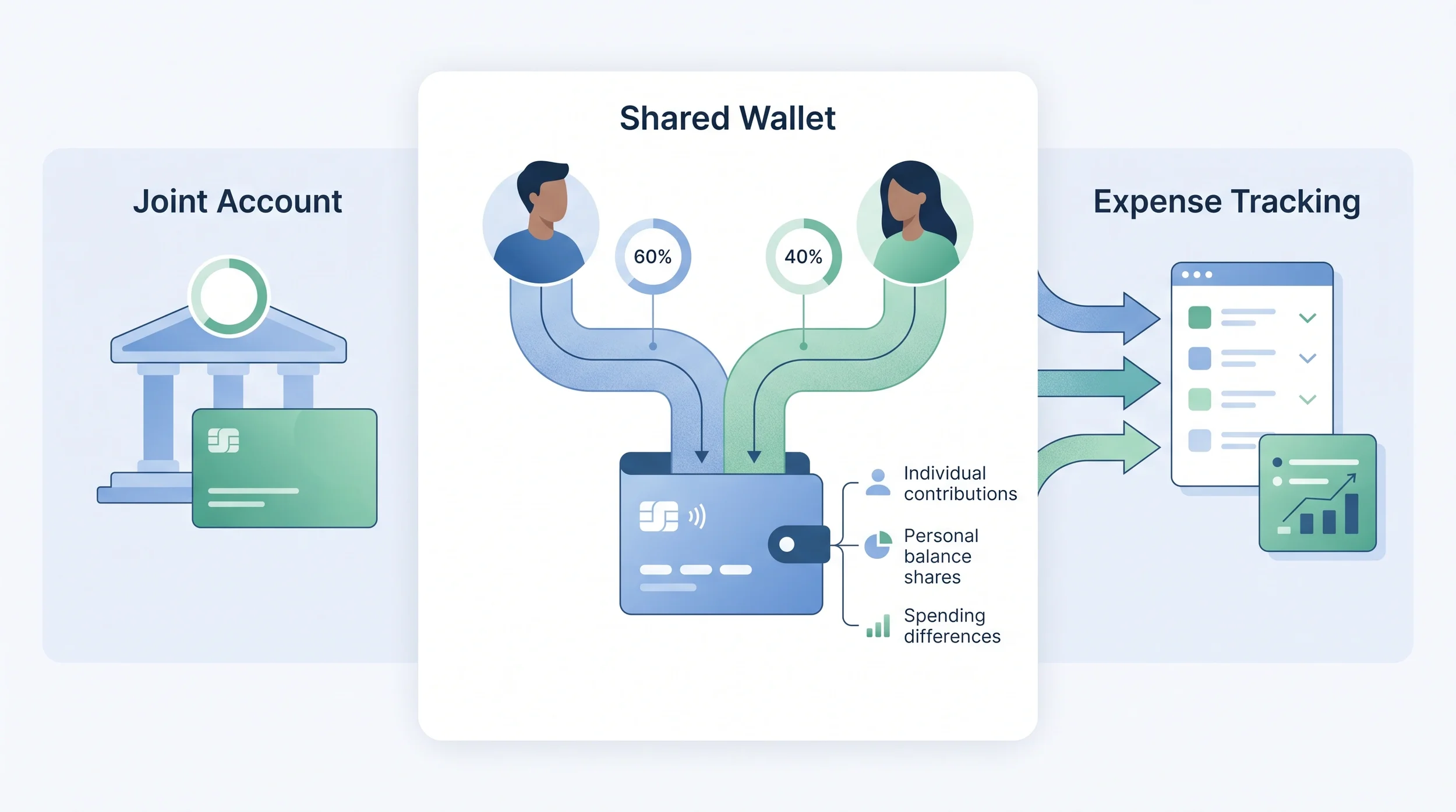
Image generated with AI
9 min read
Managing money together doesn't necessarily mean combining your finances.
Many couples want to share the cost of groceries, rent, holidays and everyday purchases while maintaining their financial independence.
But when one partner earns more, contributes differently or regularly pays for shared expenses, keeping track of what feels fair can become complicated.
Joint bank accounts and expense tracking apps offer two familiar solutions. A shared wallet introduces a third approach: spending together while maintaining visibility into individual contributions.
There are several approaches to how couples manage money, each offering different levels of financial independence, transparency and convenience.
Joint Bank Accounts: Combining Money Into One Place
A joint bank account is one of the most established ways for couples to manage shared finances.
Both partners can access the same account, deposit money and use the balance for shared expenses such as rent, groceries, bills and everyday purchases, subject to the account's terms and access permissions.
The main advantage is simplicity.
There is one account, one balance and one transaction history.
A joint account can work well for couples who want to combine their finances or maintain a dedicated account for shared household expenses alongside their individual bank accounts.
However, a traditional joint account is designed around one combined pool of money.
The account shows:
deposits,
withdrawals,
transactions,
remaining balance.
What it does not typically show is how shared spending affects each person's individual contribution share over time.
For example, imagine two partners agree to fund their shared expenses differently. One contributes 60% of the money and the other contributes 40%.
After months of spending, the joint account will still show one combined balance. Understanding how much of that remaining balance can be attributed to each partner, or whether contributions and spending remain aligned with their agreed arrangement, may require additional tracking or calculations.
The money is shared, but individual visibility within that shared balance can become less clear.
The choice between joint accounts and separate finances often depends on how much financial independence each partner wants to maintain.
Expense Tracking Apps: Understanding Who Paid
Expense tracking apps like Splitwise help couples manage shared expenses without creating a shared balance.
When someone pays for a shared expense, the payment is recorded in the app, which calculates how costs should be divided and keeps track of outstanding balances between partners.
This approach is useful for:
holidays,
roommates,
occasional shared expenses,
couples who prefer separate finances.
The strength of expense tracking apps is that they make individual payments visible.
They can answer:
"Who paid, and what is the difference between us?"
For example, if one person pays €80 for groceries and the other pays €20 for household items, and they agree to split costs equally, the app calculates that the second partner owes the first €30.
The main limitation is that the shared financial picture is typically created after spending takes place.
With traditional expense tracking apps, partners generally need to:
remember and record their purchases,
assign expenses to the appropriate spending categories or splitting arrangements,
keep their shared expense records up to date,
settle any outstanding amounts when necessary.
Some expense tracking apps simplify this process through automatic transaction imports, recurring expenses and predefined splitting rules.
However, their primary purpose is to record expenses, calculate each person's share and show whether money is owed, rather than provide a shared balance from which both partners can spend.
The focus is on tracking and reconciling shared expenses rather than managing shared funds directly.
Shared Wallets: A Shared Balance With Contribution Visibility
A shared wallet is a newer approach designed for couples who want a dedicated place for shared spending without fully combining their personal finances.
Instead of putting all money into one account, both partners can add money to a shared balance while keeping track of how each person contributes.
Shared wallet functionality varies between providers. In NOUETO's proposed model, partners can add money to a shared balance and define how shared spending is allocated between them, either through a default spending ratio or category-specific percentages.
For a more detailed explanation, explore how a shared wallet works and how it can be used to manage everyday shared expenses.
For example, imagine a couple agrees to a 60/40 spending arrangement.
Partner A tops up €600.
Partner B tops up €400.
The shared wallet now contains €1,000 while keeping track of each person's individual contribution.
The difference becomes clearer when spending begins.
When the couple spends €100 on groceries from the shared balance, the purchase is automatically allocated according to their agreed spending percentages:
€60 is attributed to Partner A's share.
€40 is attributed to Partner B's share.
Neither partner needs to manually record the purchase or calculate how the expense should be divided.
The following table illustrates how the shared balance and each partner's attributed balance change after the purchase.
Example: A 60/40 Shared Spending Arrangement
| Description | Partner A | Partner B | Total |
|---|---|---|---|
| Initial contribution | €600 | €400 | €1,000 |
| Agreed spending ratio | 60% | 40% | 100% |
| Grocery spending | −€60 | −€40 | −€100 |
| Remaining attributed balance | €540 | €360 | €900 |
Illustrative example based on NOUETO's proposed shared wallet model. Attributed balances reflect the agreed spending allocation and do not necessarily represent legal ownership of funds.
Use our shared expenses calculator to explore how different spending ratios could work for your household.
Both partners can see how much money remains available for shared spending and how the purchase has affected their respective attributed balances.
Over time, NOUETO's proposed shared wallet model aims to show:
how much each person has contributed,
how shared spending has affected each person's share,
whether contributions remain aligned with the agreed spending arrangement,
whether an adjustment to contributions may be needed.
This creates a different type of financial visibility.
A traditional joint account shows the total money available and the transactions that have occurred.
An expense tracking app shows who paid, how expenses are divided and whether reimbursement is needed.
NOUETO's shared wallet approach connects contributions, spending and remaining attributed balances within a single shared spending space.
Table 1. The Key Differences
| Comparison | Joint Bank Account | Expense Tracking App | Shared Wallet |
|---|---|---|---|
| Main purpose | Pool money in a shared bank account | Track shared expenses and calculate individual shares | Create a shared spending balance while maintaining contribution visibility |
| Where money sits | In a joint bank account | Typically in each person's personal account | In a dedicated shared wallet balance |
| How money is added | Partners deposit money into the account | Typically no shared balance to fund | Partners add money and define agreed spending ratios |
| After spending | Shows transactions and the remaining account balance | Shows who paid, how expenses are divided and whether money is owed | Automatically updates the shared balance and each partner's attributed balance |
| Contribution visibility | Individual deposits are visible, but the remaining balance is pooled | Shows payments made by each person | Shows individual contributions and how spending affects each partner's attributed balance |
| Understanding the difference | May require additional tracking or calculations | Calculates outstanding amounts between partners | Shows how contributions and spending relate to the agreed spending arrangement |
| Shared spending | Paid directly from the joint account | Typically paid from personal accounts | Paid directly from shared funds |
| Manual tracking | Low for transactions; additional tracking may be needed for individual contributions | Varies depending on available automation features | Designed to reduce manual tracking through automatic spending allocation |
| Financial separation | Shared funds are pooled, while personal accounts can remain separate | Personal finances can remain separate | Personal finances remain separate while shared spending is organised |
| Main question answered | “How much money do we have together?” | “Who paid, and who owes whom?” | “How are we contributing and spending together?” |
Shared wallet functionality varies between providers. This comparison reflects NOUETO's proposed shared wallet model, which is currently in development.
For a closer look at banking functionality, individual positions and shared spending, explore the differences between joint accounts and shared wallets.
Understanding Financial Protection and Ownership
When choosing how to manage shared money, couples should also consider who has access to their funds, how ownership is determined and what financial protection applies.
In the European Union, eligible bank deposits are generally protected up to €100,000 per depositor, per bank, in the event of bank failure.
Expense tracking apps typically do not hold customer funds, so financial protection depends on where each person keeps their money.
For shared wallets, financial protection depends on the underlying regulated financial structure. Where safeguarding requirements apply under EU electronic money or payment services legislation, they are designed to protect customer funds but are not equivalent to statutory bank deposit protection.
Ownership, access permissions and withdrawal rights depend on the provider's terms and applicable law.
Three Approaches, Three Different Questions
Each approach to managing shared money focuses on a different financial need.
Joint bank account
“How much money do we have together?”
Focus: Pooled money.
Expense tracking app
“Who paid, and who owes whom?”
Focus: Expense reconciliation.
NOUETO's shared wallet approach
“How are we contributing and spending together?”
Focus: Ongoing shared money management.
The difference is not simply where money is held, but how contributions, spending and remaining balances are connected.
A Different Way to Manage Shared Spending with Noueto
Managing money together shouldn't mean losing sight of your individual contributions or constantly calculating who owes what.
NOUETO is building a different way for couples to manage shared money — bringing everyday spending, individual contributions and financial clarity together in one shared wallet.
With NOUETO, couples are expected to be able to:
Keep their financial independence while creating a dedicated balance for shared expenses.
Share costs in a way that works for them, rather than automatically splitting everything 50/50.
Pay directly from shared funds, reducing the need to settle expenses afterwards.
Stay informed about their individual contributions and how everyday spending affects their respective balances.
Whether it's groceries, household bills, holidays or everyday purchases, NOUETO aims to make managing shared money simpler, clearer and more transparent for both partners.
Spend together. Stay independent. Know where your money goes.
NOUETO is currently in development. Join our waitlist to be among the first to experience a different way of managing money together.
Choosing the Right Approach
There is no single solution that works for every couple.
A joint account can make sense for couples who want to pool some or all of their money and prefer managing shared expenses through a traditional banking structure.
Expense tracking apps can be useful for couples who want to keep finances separate while splitting occasional costs.
A newer approach to shared money management is a shared wallet that combines everyday spending with individual contribution tracking.
Rather than simply pooling money or recording expenses after payment, this approach allows couples to fund a shared balance, define how expenses should be allocated and maintain visibility into their individual contributions and remaining attributed balances as they spend together.
NOUETO is being developed around this approach.
For couples who value financial independence, managing shared finances without merging accounts can offer a way to organise shared spending while maintaining separate personal finances.
The important difference is not only where money is stored. It is how clearly couples can understand the relationship between contributions, spending and shared financial decisions.
Frequently Asked Questions
-
A joint account is a bank account held jointly by two or more people, providing access to a common balance under the account's agreed terms. Eligible bank deposits also benefit from statutory deposit protection. In the European Union, this generally covers up to €100,000 per depositor, per bank, in the event of bank failure.
A shared wallet provides a dedicated space for funding and managing shared expenses. Depending on its functionality, it may also track individual contributions, allocated spending and remaining individual financial positions within the shared balance.
Unlike a traditional bank account, a shared wallet is not necessarily a bank deposit. The protection of funds depends on the provider, its regulatory status and how customer funds are held. Electronic money safeguarding, where applicable, is different from bank deposit protection.
-
Expense tracking apps and shared wallets serve different purposes.
An expense tracking app primarily acts as an accounting tool. It records who paid, allocates expenses between partners and calculates their respective financial positions, including whether one person owes money to the other. Recording or splitting an expense does not necessarily involve transferring or settling money.
A shared wallet allows couples to fund shared spending in advance and, where supported, pay directly from a shared balance. Wallets with contribution tracking can also connect actual contributions with allocated expenses and remaining individual positions.
The better option depends on whether couples want to track shared expenses retrospectively or manage and spend shared funds directly.
-
Yes. Depending on the provider, couples can maintain their individual bank accounts while contributing money to a dedicated shared wallet for common expenses.
This allows personal finances to remain separate while creating a common balance for everyday spending. Access permissions, withdrawal rights, legal ownership and financial protection depend on the wallet's underlying structure and terms.
-
Yes. Couples can agree on a proportional split, such as 60/40 or 70/30, based on their income or financial preferences.
With traditional expense tracking apps, partners typically need to remember and record their purchases. For example, after paying €100 for groceries, they record the expense and the app calculates each person's share and whether anyone owes money.
With NOUETO, partners will be able to set a spending ratio in advance, either for all shared expenses or for specific spending categories. When they spend €100 from their shared wallet, NOUETO automatically applies the agreed split, such as €60 and €40, and updates each partner's remaining attributed balance.
There is no need to manually record purchases or decide how to split each expense.
-
Couples who prefer not to open a joint bank account can consider separate accounts with regular transfers, expense tracking apps, shared payment solutions or shared wallets.
Expense tracking apps are useful for understanding each partner's financial position without pooling money. Shared wallets can provide a dedicated balance for shared spending while allowing couples to maintain their individual bank accounts.
The right alternative depends on whether couples need expense reconciliation, direct access to shared funds, individual contribution tracking or specific banking protections. Not every alternative offers the same functionality, legal rights or protection as a joint bank account.
Looking for tools to manage shared spending? Explore our Shared Money Tools guides and comparisons covering shared wallets, joint accounts and expense tracking apps.
This article is for general informational purposes only and does not constitute financial advice. Financial products, features, and protections may vary by provider and jurisdiction. Readers should consider their own circumstances and seek professional advice where appropriate.
About our content
NOUETO publishes educational content about shared expenses, household budgeting and financial independence for couples. Learn more about our editorial policy.